
Card Solitaire: seven habits that win more deals
Every deal of Card Solitaire is a small puzzle with some luck built in. You cannot control which cards are face down, but you can control the order in which you uncover them, and that is where most deals are won or lost. These are seven habits that careful players share. If you do not know the rules yet, our full guide covers them in a couple of minutes.
Habit 1: look at the whole table first
It is tempting to grab the first legal move you spot. Resist it for a few seconds. Scan the seven columns, the top of the waste pile and the four suit piles, and list what is possible.
Here is why it matters. Only the top card of the waste pile can be played. Draw before you have checked the columns, and the card you were holding is buried under the new one, out of reach until the pile comes round again. A five-second scan often shows that the card you had would have fitted somewhere after all.
Habit 2: dig where the most cards are hidden
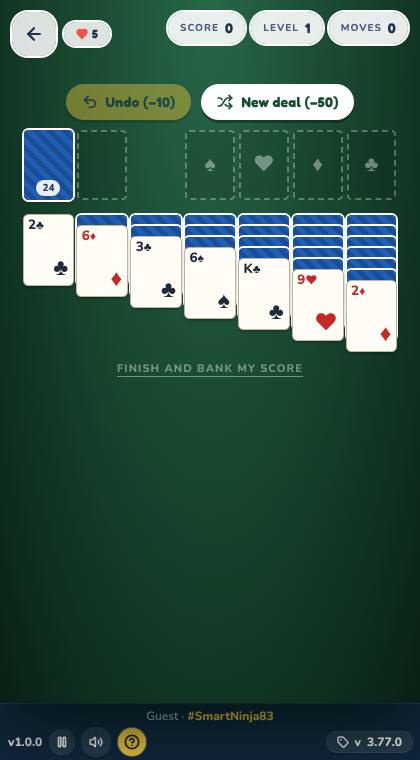
The deal starts with columns of one to seven cards, and only the last card in each is face up. The tall column on the right hides six cards, while the short one on the left hides none. Uncovering the tallest columns first gives you the most new cards, and the most new places to put things.
Turning a face-down card over also scores 5 points times your level. When two moves look equally good, choose the one that takes a card off a column with hidden cards beneath it.
Habit 3: keep the waste card in reserve
The card showing on the waste pile stays put until you draw again, so it is a patient helper. Suppose a black 7 is waiting and you have two red 6s that could go on it: one on top of the waste pile, one at the end of a column with a face-down card beneath it. Play the column card. It turns over a new card and gives you fresh options, and the waste 6 is still there for the next black 7, or for its suit pile.
Habit 4: guard your empty columns
Only a king can fill an empty column, so a gap is only as useful as the kings you can find. Clearing a column early feels like progress, but with no king in sight you have simply lost a place to park runs.
Moving a king that already sits at the top of its column onto an empty one gains nothing, either. You swap one gap for another. Empty a column deliberately, when a king is ready to take its place.
Habit 5: send the low cards up, hold the middle ones back
Aces and twos can almost always go straight to their suit piles, as they are rarely needed as landing places. Middle cards are different. A black 6 on the table is a place where a red 5 can land. Send it up too soon and that 5 may have nowhere to go.
A good rule of thumb is to keep the four suit piles roughly level, within two or three ranks of each other, until the late game. Taking a card back off a suit pile costs 15 points, more than the 10 it earned for going up, so think before you send it.
Habit 6: learn the rhythm of the pile
Cards come off the draw pile one at a time, and you can turn the waste back over as often as you like. The pile is never a dead end, and each pass shows the cards in the same order, less any you have played.
So pay attention on the first pass. If a red 6 turns up two draws after a black 5, you know that if you free a black 7 before the next pass, that 6 will be waiting. A good second pass is planned on the first.
Habit 7: use Undo to think, and know when to stop
Undo costs 10 points and can step back through up to 200 moves. That is cheap enough to test an idea: play a move, look at the result, and undo it if it was wrong. What does not pay is undoing over and over to find a lucky path.
Know when a deal is finished with you, too. When the table says there are no useful moves left, you can Undo to your last real decision or take a New deal for 50 points. If a stuck deal cannot be rescued, a fresh one is usually worth the price. And once every card is face up and the draw pile is empty, use Finish the deal and let the game send the rest up.
A practice routine
For your next five deals, say aloud before your first move which column you will dig into and why. Never draw while a column move is available. On your second pass through the pile, name the card you expect next. You will miss at first, then you will start getting it right.
Time for a deal
The Daily challenge is a fine place to practise: the same deal for everyone, one scored try a day and its own leaderboard. For a quieter session, Play Card Solitaire and try one habit at a time.
If you like clearing a table by careful thinking, you might also enjoy Mahjong Solitaire, where the order you remove tiles matters just as much, or Sudoku.