
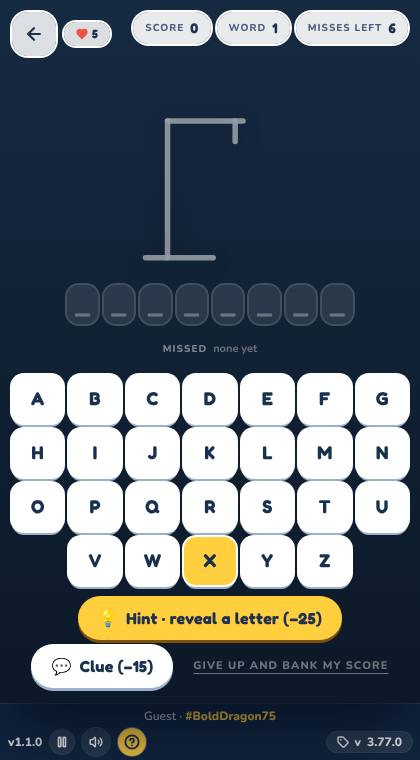
Hangman guessing tips: smarter letters, better patterns, longer runs
Hangman looks like a game of pure guessing, but the people who last longest are doing something more careful: they treat every letter as a bet and pick the one with the best odds. This guide explains how, using the way the game really works. The basic rules are in the full guide, so we can go straight to strategy.
Think in odds, not hunches
Each wrong letter draws another part of the figure, and run out of misses and the word beats you. So the aim of your first guesses is simple: choose letters likely to be in the word, so each guess either fills tiles or at least rules something out.
In ordinary English, E is the most common letter, with A, O, I, T, N, S and R close behind. Vowels are the sensible place to begin, because most words need at least one and a hit gives you a skeleton to build on. The game's own guide says the same: try the vowels, then the common consonants such as R, S, T, L and N.
Adjust for length. A three or four letter word usually has just one vowel, so one good hit settles most of it. Longer words often have two or three, so work through the vowels before you lean on consonants.
Read the blanks like a puzzle
Once a letter lands, stop guessing from the alphabet and start guessing from the shape of the word.
- Position matters. If E lands on the very last tile, a consonant such as R, L, D or T often sits just before it. Endings are the easiest part of a word to recognise.
- Count the tiles a letter fills. If a letter fills two tiles that are not side by side, you now know the word repeats that letter, which cuts down the possibilities sharply.
- Look for gaps you can fill. A word showing a few letters with single blanks between them usually has few words that fit. Say the pattern aloud and try the likeliest letter in each blank.
- Do not forget the misses. The ✕ marks show you what the word does not contain. If A and E both missed in a longer word, look for the vowels you have not tried yet: I, O and U.
Let the categories shrink the search
On the start screen you can pick a word category: Animals, Food, Nature or Things. Leave it on All words and anything can come up; choose one and every word comes from that group. Say you pick Food: a pattern with a few letters showing now has far fewer possible answers, because you are only searching foods of that length. Picture a short list of candidates and test the letter that tells them apart. The Daily challenge always uses all words, so category practice is a warm-up rather than a perfect match.
Clues and hints: spend them wisely
Both are optional, and both cost points on that word.
- Clue. A short riddle about the word. It costs 15 points if you ask for it, but it appears for free once you have missed twice. So the cheap approach is to see whether you can solve the word without it. If you are going to miss twice anyway, you get the riddle at no cost.
- Hint. Reveals one hidden letter, once per word, for 25 points. It picks a letter at random among those still hidden, and it will never reveal the very last one, so it helps but does not solve the word for you. Use it when you have no useful pattern and your next guess would be a stab in the dark.
A clue suits a word you cannot picture at all, because it narrows many letters at once. A hint suits a word you can half see but cannot spell.
Play for survival, not perfection
A word is worth 10 points for each letter, multiplied by the word you have reached, plus 10 for each miss you did not use. A longer word later in the run is worth far more than the spare-miss bonus, so what matters most is not getting caught.
The room to miss also shrinks as you progress. You get six wrong letters for the first four words, five from word 5 and four from word 8, while the words grow from three and four letters up to eight and nine. So the early words are the place to be bold and practise, and the later ones are where the careful odds work really pays.
A little practice routine
- In your first few games, say your reason for each letter before you press it.
- Try a category you enjoy and play it until the patterns feel familiar.
- Notice which words catch you out, such as those with doubled letters, and watch for them.
- When you feel ready, try the Daily challenge. Everyone gets the same words that day, you get one scored try, and it has its own leaderboard.
The game remembers the words it has shown you on your device, so you will not see the same one twice: you are learning to read patterns, not to remember answers.
If you enjoy spotting what is missing, Missing Letter is a gentle companion game, and Word Scramble trains the same eye for letter patterns.
Time to play
Next round, begin with a vowel, watch where it lands, and let the blanks guide you. Play Hangman and see how many words you can chalk up before the figure is complete.