
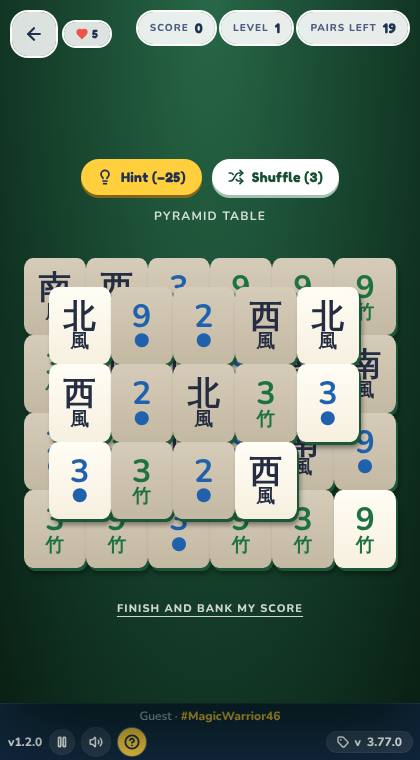
Mahjong Solitaire: how to clear the table without getting stuck
Mahjong Solitaire looks like a matching game, and at the very start it feels like one: find two tiles that are the same, tap them, watch them vanish. But the table you are clearing is built in layers, and the pair you choose now decides which tiles you can reach later. Players who clear table after table are not quicker at spotting matches, just better at choosing between them. If you are new to the game, the full guide explains the basics. This article is about what to do once you know them.
Read the table before you tap
A tile is free when nothing lies on top of it and its left or right side is open. Covered tiles look darker, and tiles in the middle of a row are blocked until a neighbour goes.
Take a moment to see how the shape is built. In the pyramid, each upper tile rests across the joins between tiles below, so one tile on the bottom layer can be covered by as many as four above it. You will often have to take a whole block off the top before a single tile underneath is free. The table rotates through pyramid, turtle, bridge and wall layouts as you climb, and the name of the current one is shown above the board, so glance at it to see where the thick stacks are.
Work from the top and from the ends
- Top layers first. Every tile you lift from a stack may free one or more tiles below it.
- Row ends first. A tile at the end of a row has one open side. A tile in the middle needs a neighbour gone first, so the middle of a long row is the last place to be freed. Start at the ends and work inwards.
Before you take a pair, ask what it opens. If one pair frees two new tiles and another frees none, take the first.
Choosing between several matches
In this game, a 3 of dots matches only another 3 of dots, not a 3 of bamboo, and every picture appears an even number of times on the table. Often it is two tiles, but it can be four, six or more. The choice you face is when three or four of the same picture are free at once.
Say you can see three free tiles with the same picture: one on top of a tall stack, one at the end of a row, and one on its own at the far edge. Take the pair that unlocks the most, and leave the one that blocks nothing. A leftover tile at the edge of the table is no trouble. A leftover in the middle of a stack may be.
Notice also that tapping a tile that does not match costs nothing. It just moves your selection, so you can tap around freely while you think. Tapping a covered tile only makes it flash.
Beware the locked pair
This is the classic way to get stuck. Suppose only two tiles of a picture remain, and one of them sits directly on top of the other. The top one can only leave by pairing with the one beneath it, but the one beneath cannot be touched until the top one has gone. Neither will ever move.
The game deals every table so that some order of pairs will clear it, but that does not rescue you if you choose a different order. When you have a choice, check before you take a pair whether you are about to leave a stacked twin behind.
Shuffles and hints
You begin with three shuffles and earn one for each table you clear, up to five. A shuffle deals the remaining pictures out again among the tiles that are left, and the new deal can always be cleared.
- If you have spotted a locked pair while other matches still exist, use a shuffle at once. The game only shuffles for you when no pair is left at all, so playing on only wastes moves.
- If no pairs are left and you have no shuffles, the run ends and costs a life.
A hint costs 25 points, which is more than a pair earns on level 1, and it shows you a pair that exists rather than the best pair. Use it to check whether a move exists, not to choose between moves.
Do not chase the quick bonus
A pair scores 20 points times your level, and a pair matched within five seconds of the last one adds a flat 10. That bonus is small, and it never grows with the level. Rushing to catch it can cost you a good pair. Clearing the table banks 100 points times the level, and a thoughtful run earns that far more reliably than a fast one.
A practice routine
On your next table, point to the thickest stack before your first tap and plan to take it down. Whenever three matching tiles are free, say aloud which two you will take and which you will leave. After a few tables you will see locked pairs coming a long way off.
The Daily challenge is a good test. It gives everyone the same table, one scored try a day and its own leaderboard, so you can see how your choices compare.
Time to play
Ready to clear a table? Play Mahjong Solitaire and try out what you have read. If you enjoy hunting for pairs, Memory Match tests a different skill, and Card Solitaire rewards the same careful, think-ahead habits.