
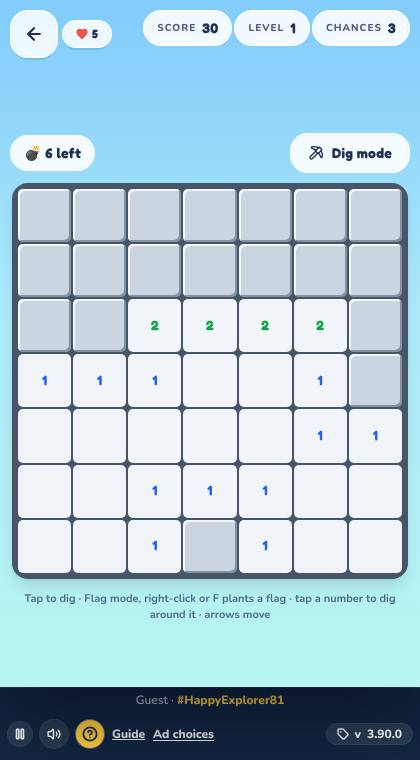
Mine Sweeper for beginners: how to read the numbers and clear the board
Many first games of Mine Sweeper go the same way: dig, dig, dig, boom. The trouble is rarely bad luck. It is that the numbers were never being read. Each one is a clue, and a few habits turn a board of guesses into a board of answers.
This article skips the button-by-button basics, which the full guide covers, and focuses on thinking. To try each idea as you read, Play Mine Sweeper alongside.
What a number really tells you
An opened square shows how many mines touch it, diagonals included. That is up to eight neighbours in the middle of the board, five along an edge and only three in a corner.
Two facts follow, and nearly every technique grows from them:
- If a number equals the count of unopened squares around it, all of those squares are mines.
- If a number already has that many mines flagged, every other unopened square around it is safe.
So begin each move by asking, "How many unopened neighbours does this number have?"
Start in the middle, then work the edge
Your first dig is always safe, and the game keeps the squares around it clear when the board has room, so you usually get a patch to work from. A dig near the middle tends to open up more than one in a corner.
After that, stay on the border of the opened patch, where numbers meet unopened squares. Every deduction lives there, and each safe square you open creates new numbers and new deductions.
Three deductions that solve most boards
The lonely 1. A 1 with only one unopened neighbour tells you that square is a mine. A 1 in a corner has three neighbours; if two are open, the third is the mine.
The satisfied number. Once you flag the mine beside a 1, that 1 is finished. Dig every other unopened square touching it.
The overlapping pair. This is the one that separates beginners from regulars. Compare the unopened squares of two neighbouring numbers.
- A 1 touches only squares A and B. Its neighbouring 1 touches A, B and C. The mine for the first number sits in A or B, which already satisfies the second, so C is safe.
- A 1 touches only A and B, and a neighbouring 2 touches A, B and C. The 2 needs one more mine than the 1 can explain, and the only extra square is C, so C is a mine.
Whenever one number's unopened squares sit inside another's, subtract and you have your answer.
The 1-2-1 pattern
Picture three opened numbers in a row along a straight edge, reading 1, 2, 1, with a row of unopened squares beside them and nothing else unopened nearby. That row has five squares: one beyond each end and three beside the numbers.
Suppose the mine sits beside the middle number. It would satisfy both 1s, leaving the 2 needing a second mine, and any second mine would break one of the 1s. Impossible. The only arrangement that works is a mine beside each 1, with the other three squares safe. Flag those two, dig the rest.
Chording, and how it goes wrong
When a number has as many flags around it as its value, tapping the number digs everything else around it at once. It is the quickest way to clear a finished area.
The catch is that chording trusts your flags. A flag alone does no harm, but one wrong flag behind a chord means digging a real mine and losing one of your three chances. Before you chord, check that you can explain every flag around that number.
The counter above the board shows how many mines are left, falling with each flag. Near the end it is a handy check: if it reads zero while unopened squares remain, they are all safe, provided your flags are right.
When you truly have to guess
Boards are laid out at random, so occasionally every number is stuck. Guess as cleverly as you can:
- Finish every sure move first. A guess is only for when nothing certain is left.
- Compare the odds. A square beside a 1 with four unopened neighbours is roughly a 1-in-4 risk. A square beside a 2 with three unopened neighbours is far worse.
- Consider somewhere quiet. At level 1 there are 6 mines among 49 squares, so an unknown square away from the numbers can be a better bet than a risky one beside them.
- Prefer a guess that opens up information over one that tells you nothing new.
A short practice routine
Go slowly on the early levels. Each safe square scores a point times your level and clearing a board adds 50 times your level, so careful play pays better than speed. A mine costs a chance and deals a fresh board at the same level.
- Play a few boards with flags and digs only, no chording, so you notice each deduction.
- Say each one aloud: "This 1 has one neighbour left, so it is a mine."
- Bring chording back once you can predict the numbers before you tap.
- After a board that ended in a guess, look back for a pattern you missed.
Boards grow from 7 by 7 up to 12 by 12 as you climb, with more mines. The same reasoning works throughout; there is simply more of it. If you enjoy proving each move before you make it, Sudoku rewards the same habit.
Ready to sweep?
Next time, try to reach the end of a board without a single guess. Play Mine Sweeper, read the border of the patch, and see how far the numbers carry you.