
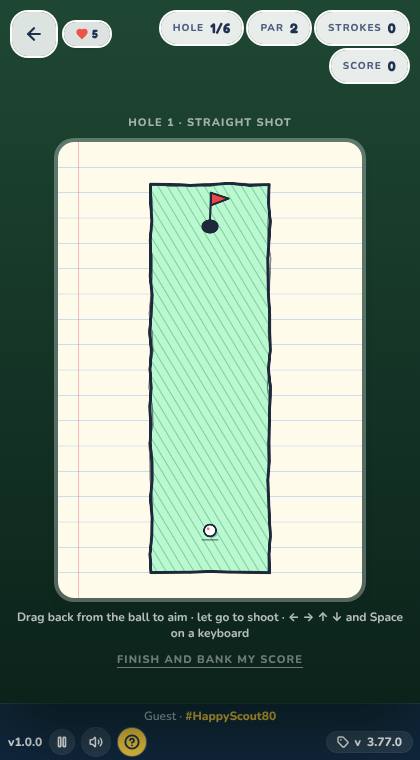
Mini Golf Doodle: read the hole, then keep your strokes down
Pulling back and letting go takes seconds to learn in Mini Golf Doodle. Getting round a hole in par takes a little more thought, and every stroke you save is worth 100 points. This guide is about the habits that save them. If you want the controls first, the full guide has them.
Look before you drag
Spend a few seconds on the hole before you touch the ball. Find the tee and the cup, then look for what sits between them: a wall that cuts the corner, a block on the straight line, a patch of sand, a pond, a sliding bar.
Then ask one question: is there a clear straight line from the ball to the cup? On the first hole there is. On most others there is not. If the line is blocked, you can go round or bounce round, but plan it before you pull back. The dotted arrow shows your direction and roughly how hard you are hitting. It does not show where the ball will end up, and it does not show bounces.
Power: two rules
The ball slows down by itself on grass, so a long shot needs a long pull and a short putt needs a gentle one.
- Near the cup, ease off. A ball that reaches the cup too fast skips over it. To drop in, it must be moving at less than about 60 per cent of the fastest possible shot as it crosses the cup. On a long hole even a firm shot has slowed enough by the time it arrives. On a short putt it has not.
- Through sand, push hard. Sand slows the ball sharply, so a gentle shot may stop dead on it. Cross it firmly, or aim around it.
Nothing happens until you let go, either. If you dislike your aim, drag back to the ball until the arrow vanishes and release: no shot is taken and no stroke is counted.
Use the walls
Walls bounce the ball like a mirror, keeping about four-fifths of its push into the wall. That makes bank shots predictable, and there is a neat way to plan one. Imagine the cup reflected on the far side of the wall, and aim at that reflection. The ball will bounce off the wall and head for the real cup.
A worked example is The dogleg. The cup is round the corner, so the direct line is blocked by the inner corner. Mirror the cup in the left-hand wall: you will be aiming up and to the left, well past the edge of the board. The ball meets the wall about halfway up the first section, swings across, clears the inner corner and heads for the cup. It is a long route, so it needs a firm pull.
Plan in short steps
Par is often three or four, so think in short steps. Your first stroke does not have to be perfect. Its job is to leave you a clear, short, straight putt. On The dogleg, a safe first stroke goes round the corner and stops in the wide upper section. The second is then easy to judge, and an easy putt is a gentle one.
Hazards, one at a time
Water. If the ball touches water, it returns to where you last hit from and you add a stroke. A splash therefore costs the shot you just took plus a penalty stroke. On Puddle pond the water covers the left of the fairway, so a shot straight up from the tee is a splash. The dry strip on the right is your route.
Blocks and sand. On Sandy bumper a block sits on the straight line to the cup, and the sand stretches right across the fairway. You cannot avoid the sand, so cross it firmly and consider banking round the block.
Sliding bars. The bar on Windmill bar travels only as far as its own length, so one side of the fairway is always open. But the dead-centre line is always covered, so a shot straight up the middle always meets it. The bar keeps moving while you aim, so watch a few swings first. It takes a little over a second to cross, so aim for where the bar will be, not where it is now.
Count the cost of every stroke
A hole scores 300 for par, 100 more for each stroke under it and 100 less for each stroke over, with a minimum of 50. A hole in one scores 500. If the ball is not down after par plus four strokes, the hole ends with no points.
That tells you how bold to be. On the first hole, going for the hole in one costs little, because a firm shot that misses usually leaves a short putt. Where there is a pond or a bar, avoid heroics: a splash wastes two strokes at once. Take the safe route and accept par.
A practice routine
Replay one hole three times with a different plan each time: a direct shot, a bank shot and a safe two-stroke route. Each hole remembers the fewest strokes you have ever taken to sink it, so you always have a number to beat.
Once you have played every hole of Doodle Meadow to the end, the second course, Tricky Trails, opens, using the same walls, sand, water and bars in tighter places. The Daily challenge is three shared holes, the same for everyone today, with one scored try a day.
Time to tee off
Play Mini Golf Doodle and try the mirror trick on The dogleg. If you enjoy judging power and angle, Pinball Arcade rewards the same feel for a bouncing ball, and Stack Tower is a good test of timing.