
Sudoku first steps: a gentle route from first puzzle to confident solver
A Sudoku grid can look like a wall of numbers. It is actually a very polite puzzle: no arithmetic, no trivia, and every puzzle here has exactly one solution. Each number you place is the only one that could go there, which means you never need to guess. You only need to learn where to look.
This is a route for complete beginners, built around the tools the game gives you. The rules are in the full guide; here we focus on how to think.
The one rule behind everything
Every row, every column and every 3 by 3 box must contain the numbers 1 to 9 exactly once. That single rule is the source of every technique. A square can never hold a number that already appears in its row, its column or its box.
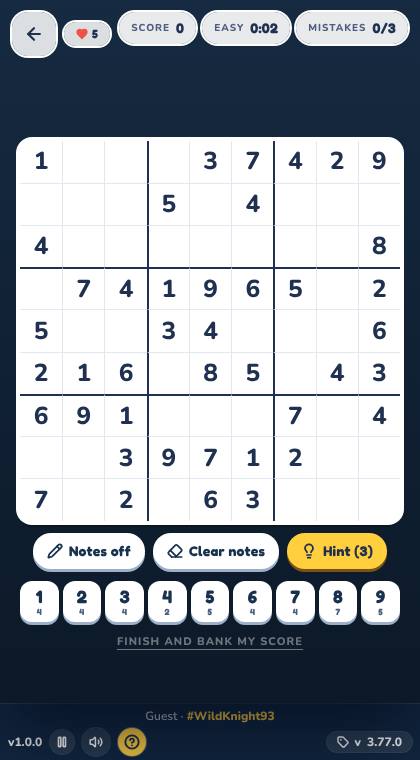
When you tap a square, the game tints that square's row, column and box. Those are the squares that "see" it, and they are the only places you need to check.
Step one: start on Easy
Choose Easy first. It begins with 42 numbers filled in, against 34 on Medium, 28 on Hard and 24 on Expert. More starting numbers means more easy moves, which is exactly what you want while the habits are new. Move up when Easy stops feeling like a puzzle and starts feeling like a routine.
Step two: scan for a number, not a square
Instead of staring at one empty square, pick a number and hunt for where it can go.
Tap a 7 that is already on the grid and every 7 lights up. Now look at one box that has no 7. Suppose the two boxes beside it, in the same band, have their 7s in the top row and the middle row. Those rows are out for this box, so its 7 must go in the bottom row of the box. If only one square there is empty, you have found your place.
The number pad helps too. Each key shows how many of that number are still to place, so start with the digits that have the fewest left. The ones that appear most often on the grid are the easiest to finish.
Step three: the square with only one choice
Now look the other way, at a single square and everything that sees it. Say its row holds 1, 2, 3 and 4, its column holds 5, 6 and 7, and its box holds 8. Only 9 is left. That is a square with just one possible number, and you can place it with confidence.
Step four: let Notes do the remembering
When scanning stops producing answers, turn Notes on. Notes lets you tap several small numbers into a square, to record what it could still be. Notes are not filled in for you, so build them one square at a time, starting where the choices are fewest.
When you place a number, the game removes it from the notes of every square that sees it, so your notes stay tidy. If a square is down to a single small number, that is its answer.
A related idea is the number with only one home. Look along a row. If the number 4 appears in the notes of only one square in the row, that square must be the 4, even if it also lists other candidates.
Step five: pairs
Once those moves run out on harder puzzles, try pairs. If two squares in the same row each have only the notes 3 and 8, then the 3 and the 8 must live in those two squares, in one order or the other. So no other square in that row can be a 3 or an 8. Remove those notes elsewhere in the row by turning Notes on and tapping the number in each square to switch it off. The game does not do this elimination for you, but clearing those notes often unlocks the next number.
Why you should not guess
The game checks every number you enter against the solution. A wrong number is not placed and uses up one of your three mistakes, and the third ends the run. Every number in a puzzle can be proved, so there is never a reason to gamble.
The scoring rewards patience. A puzzle scores 100 on Easy, rising to 500 on Expert, with a 50 point bonus for finishing without a mistake and some extra points for finishing quickly. A hint, which fills in the selected empty square, costs 50 points, and you get three per puzzle. Try Notes before a hint, and use a hint to see what you missed.
A simple practice plan
- Do a few Easy puzzles using only scanning, until finding a place for a number feels natural.
- On the next ones, turn Notes on as soon as scanning dries up.
- Keep an eye out for a single remaining note in a square, and for a note that appears only once in a row, column or box.
- Move to Medium, and try the Daily challenge, a shared Medium puzzle that everyone gets on the same day.
- Your puzzle in progress is saved, so you can pop away and use Continue from the start screen when you return.
If you like a puzzle where every move has a reason, Mine Sweeper has the same feel, with numbers as clues.
Your first grid awaits
Pick Easy, tap a number that appears often, and find where it belongs. Play Sudoku now, and take your time. There is no rush to see the answer, because the answer is already in the grid waiting for you.